

 Tadhole
 Story of a Soldier
‘and the truth is that all veterans pay with their lives, some pay at once, while others pay over a lifetime’ – J M Storm
What is it that can move a big burly man to tears 38 years after the event? How can any experience leave emotional scars that cut so deep? As he recounts the event that has, to a large degree defined his life ever since, Stan’s eyes cloud and tears of pent up emotion spill down his cheeks. Listening to his story and considering South Africa’s recent history, I can but wonder how many ‘Stans’ there are out there, putting on a brave face as they struggle to deal with demons from their past.
So what is his story?
As a teenager, Stan reported to Phalaborwa based 7 SAI [South African Infantry] in June 1983, to undergo his compulsory military service. The infantry training was a rude awakening for a kid who literally turned 17 years old a month before call-up. Roughly a year later he found himself deployed to the north of Namibia, on the Angolan border. His squad performed patrols into hostile territory and had a few ‘contacts’ with SWAPO insurgents. On one occasion a rifle grenade fired at the squad literally bounced between them without detonating…..life was asking more questions than it was providing answers.
Whilst on a routine patrol on 23rd June 1984 at around 10.20 am, life for Stan changed forever in the blink of an eye. A local interpreter, Thomas, led Stan’s four man patrol to where there was an alleged SWAPO presence. They had crossed a road known as ‘Willie se witpad’, venturing about 32 kilometres from base and searched a deserted kraal. Resting up briefly they continued the patrol. It was infantry practice after a rest, to rotate the order of patrol, giving everyone a chance to walk ‘on point’. Stan was next up ‘on point’ but was chivvied into second by his best mate, nicknamed ‘Piesang’, who pulled rank as the Corporal in charge. Stan was still rankled by this break from routine when literally, hell broke loose.
A rifle grenade fired at the squad detonated against a branch, killing Piesang instantly. A hail of AK 47 and SKS rifle fire cut down Hennie, another squad member as he sought cover. Willie, the other member, had a round detonate a phosphorous grenade on his webbing, resulting in severe burns to his body. Stan, not realising the extent of his comrades wounds, shouted ‘jaag hulle’ [‘chase them’] and advanced, firing his R4 at the ambushers. The ambushers fled from the return fire. Stan was completely unscathed. After taking stock of their situation, he recovered the radio from beneath Piesang’s lifeless body and radioed to report the ambush and request a casualty evacuation helicopter. He then tore his shirt into strips to bind his comrades wounds as best he could and removed his t-shirt to cover his best friends head, hiding the wounds that had ended his life.
The tracker and interpreter, Thomas, had fled the scene. Had they been led into the ambush? The first of many unanswered questions that swirled around in Stan’s head. About an hour after the ambush, a South African Super Frelon helicopter arrived and despite deploying a smoke grenade to alert the crew to their whereabouts and have the helicopter hover directly above them, it was only when Stan, in a terrible state and at the end of his tether, threatened to shoot a ‘Snotneus’ [Army slang for the M79
grenade launcher] at the helicopter, that the aircrew realised that they were directly above him. They then threw a stretcher down, narrowly missing Stan. He asked them what a stretcher was worth to one man standing, whereupon two medics came to his assistance.
After tending to the wounded and loading Piesang’s body, Stan, moving to board the aircraft, was told that he was ‘not wounded’ and could not be ‘casevacced’, but must stay put. The Chopper then took off and flew away, leaving a barely 18 year old scared and traumatised troopie alone in hostile territory. Around lunch time a Koevoet [SA Police] patrol arrived on the scene. A request to return to his HQ with them was also denied on the grounds that the ‘infantry look after their own’. For a second time Stan was left alone . He passed the time by studying the ambush site, finding where 12 ambushers had carefully prepared the killing zone. Rifle grenades were still lying neatly in a row, ready to be used in an instant.
In the late afternoon, seven hours after the ambush, an infantry ‘Buffel’ troop carrier eventually arrived to pick him up. Getting back to base in the dark, he was told to report to the unit chaplain who read a passage from the Bible, said a prayer and that was that. He spent the evening drawing maps and writing a report required by his superiors. Why had he survived when his best mate died, effectively in his place? Why had he emerged without a scratch whilst his buddies were seriously wounded? Why had the SWAPO retreated, when they could have advanced and wiped them all out? These questions bounced around in his head, leaving him with feelings of guilt and a deep, all consuming sadness.
Stan endured another 8 months on the border. Another contact made him realise that he had suffered too deep a trauma. An appeal to his Commanding Officer ended in him being posted him to a reaction unit which was tasked with clearing up after contacts between SWAPO and the SANDF. Effectively this meant recovering the shattered bodies of friend and foe. The futility of war became more and more apparent. Ruptured knee ligaments saw Stan flown back to 1 Military hospital in Pretoria for surgery. What confused him even more, was seriously wounded SWAPO being flown out for treatment on the same flight. One day they were required to kill them and the next do all you could to save their lives! Nothing made sense any more. Recounting this to fellow soldiers in his hospital ward resulted in a visit by Security Police threatening to ‘lock him up for 15 years’ for sharing ‘sensitive information’.
Eventually Stan was subjected to sleep therapy where he was heavily sedated for days on end. He recalls waking up sobbing. After hospitalisation he was eventually discharged G5K5 – Medically unfit. This plagued him with subsequent job interviews where his medical discharge was deemed to be a negative for subsequent employment. He moved from pillar to post, unable to settle until eventually qualifying as a toolmaker at Pretoria Metal Pressings. He developed a love for cycling, riding his bicycle to work. A stint of motorcycle racing came to an end after a serious back injury suffered in a crash on the racetrack.
Stan married and raised two children but was constantly haunted by the spectre of his military experiences. After responding to a discussion on Radio Jakaranda, Stan got to see a psychologist through the radio station’s Good Morning Angels initiative. He started making beautiful memento’s for the families of fallen soldiers as a form of therapy and started a non-profit company, ‘Wear it for the wounded’. He felt moved to do something significant to raise awareness and help for those suffering the effects of Post Traumatic Stress Disorder. He was distressed to learn that his comrade Hennie, wounded back in 1984, took his own life on Christmas day 5 odd years ago. The ambush had ultimately claimed another life…How, Stan wondered, could he help individuals and families who had suffered as he and his
friends had. How could he turn this horrific event, that had conspired to ruin their lives, into something positive. Could there be a silver lining to this dark and brooding cloud?
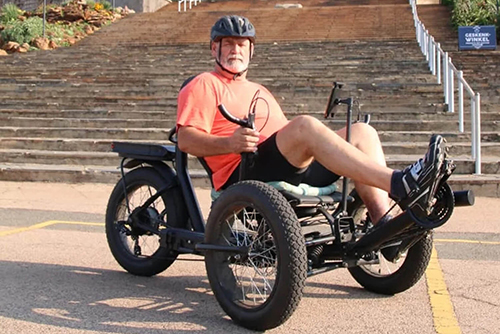
Slowly but surely a plan emerged. He had to do something that would resonate with people and capture their imagination. Stan yearns to return to the scene of the ambush as part of the healing process and to raise awareness of what so many young men endured. He started dreaming of cycling from the Voortrekker Monument, with it’s Wall of Remembrance to fallen soldiers, to the ambush site. His back injury makes riding a conventional bicycle impossible. Stan, a committed believer, met Barend, CEO of a company that manufacture recumbent Tadhole Golf carts, at a Christian men’s meeting. This sparked Stan’s dream afresh. The riding position, superb suspension and stability of the tricycle design impressed Stan immensely. Barend and his team supported Stan’s vision and literally, one month later, had an electrically assisted pedal tricycle for Stan to test. He was blown away. The dream was now becoming a reality. Training commenced immediately. This was in August 2021. The plan is to leave on 7th May 2022 and ride to Ondangwa, in the far north of Namibia by the 21st June. On the 23rd he will pedal the 32 kilometres to the ambush site.
We need to show our solidarity with those who have fought, suffered and died for a better life for us all. Irrespective of who’s side they were on, these men and women answered the call to defend what they, at that time, held dear. Victims one and all. Helpless pawns in politicians games. They deserve our thanks, love, help and support. As do the first responders, beit Police, Paramedics or Health workers, who deal with traumatic events almost daily.
How can we help?
- Donate funds to cover Stan’s costs. All surplus funds will go to help families and victims of PTSD.
- Sponsor a back-up van and camper for the duration of the trip.
- Raise sponsorship and ride along where you can, in support of the cause, either by bicycle or motorcycle.
- Brilliant opportunity for companies to gain exposure supporting a worthy cause. • Do all you can to spread the word. Let us make this huge! The world we currently live in need endeavours like this. Let us show that a collective good can have the last say over an evil that, left unchecked, could destroy us.
Donations to: Wear it for the Wounded
Capitec Bank, Branch Code: 470010
Account no: 1796134358
